Investing
Books
- A Random Walk Down Wall Street: The Best Investment Guide That Money Can Buy Thirteenth Edition by Burton G. Malkiel
- The Little Book of Common Sense Investing: The Only Way to Guarantee Your Fair Share of Stock Market Returns by John C. Bogle
- The Simple Path to Wealth: Your Road Map to Financial Independence and a Rich, Free Life by JL Collins
- The Bogleheads' Guide to Investing 2nd Edition by Mel Lindauer, Taylor Larimore, Michael LeBoeuf, John C. Bogle
- The Bogleheads' Guide to the Three-Fund Portfolio: How a Simple Portfolio of Three Total Market Index Funds Outperforms Most Investors with Less Risk by Taylor Larimore, John C. Bogle
- The Bogleheads' Guide to Retirement Planning by Taylor Larimore, Mel Lindauer, Richard A. Ferri, Laura F. Dogu, John C. Bogle
- All About Asset Allocation, Second Edition by Richard A. Ferri
Friendly Advice
I need to avoid “tax efficient” funds, since what they are trying to avoid does not apply to me.
QQQI is not a good idea, not because it uses call options, and not because of tax repercussions which do not apply to me, and not because of its 0.86% fee, but because it is too concentrated and thus not “safe”.
Cash and Bonds
When stocks go down, income has to come from something else, to avoid selling the stocks low.
Diversification
I need examples of high-quality funds in each category…
My allocation (work in progress):
- 18 months of money in safe liquid instruments (money markets)
- do I need to allocate a part of my bonds bucket to Certificates of Deposit or just increase the cash amount?
- Corporate Bonds 20%
- some portion - high-yield (junk bonds)
- Question: what portion should be junk bonds?
- Question: how is this better than a bond index fund that combines treasury and investment grade corporate funds?
- Stocks 80%
- 3/8 US grows stock fund
- 4/8 income (dividend) stock fund
- Question: why is this better than a whole-market US stock index fund?
- 1/8 international growth stock fund
Malkiel asset classes:
- Cash
- money-market fund or short-term bond fund (average maturity 1 to 1.5 years)
- Stocks
- 1/2 US stocks with good representation of smaller growth companies
- 1/2 international stocks, including emerging markets
- Bonds and bond substitutes:
- no-load high-grade corporate bond fund
- some Treasury inflation-protected securities (TIPS)
- foreign bonds
- dividend growth stocks
- Real Estate:
- portfolio of REITs
Malkiel allocation:
| age | cash | bonds | stocks | real |
|---|---|---|---|---|
| mid-twenties | 5% | 15% | 70% | 10% |
| late thirties to early forties | 5% | 20% | 65% | 10% |
| mid-fifties | 5% | 27.5% | 55% | 12.5% |
| late sixties and beyond | 10% | 55% | 40% | 15% |
Funds
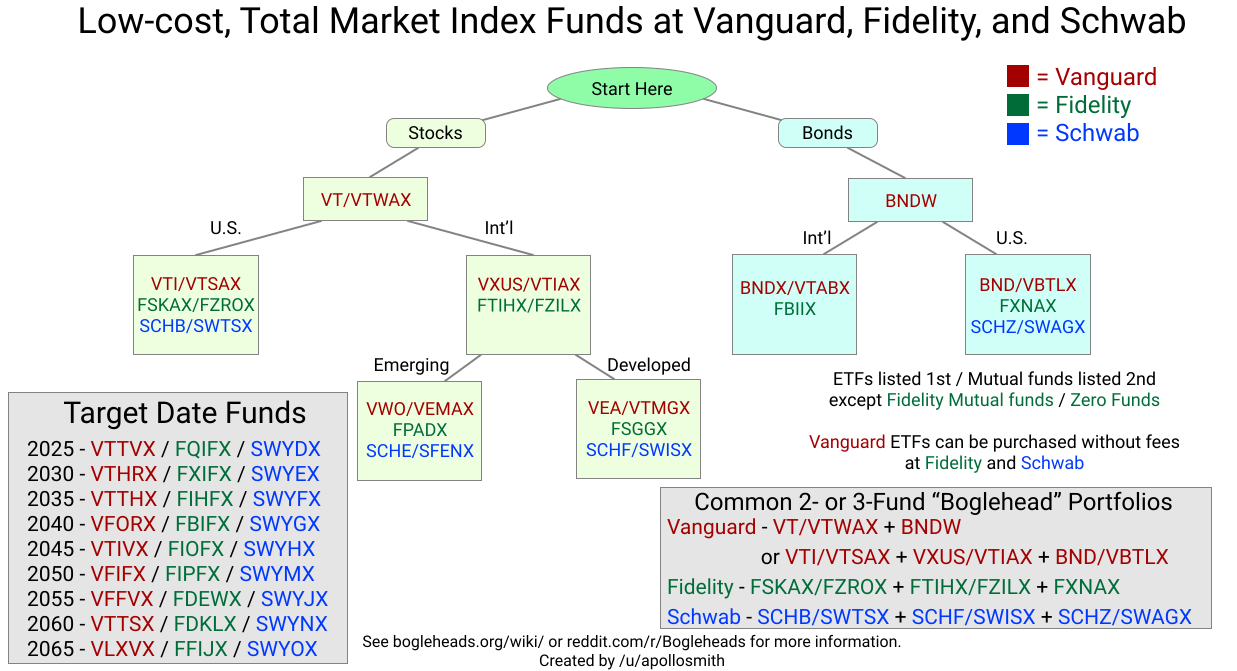
I can buy Vanguard ETFs at Fidelity with no additional fees, but for mutual funds there are fees.
| Assets | Company | Fund | Index | Expense | Notes |
|---|---|---|---|---|---|
| US Stocks | |||||
| Vanguard | VTSAX | CRSP | 0.04% | ||
| Vanguard | VTI (ETF) | CRSP | 0.03% | ||
| Fidelity | FSKAX | Dow Jones | 0.02% | ||
| Fidelity | FZROX | Fidelity U.S. Total Investable Market Index | 0.00% | ||
| Fidelity | FSTVX | Dow Jones | 0.04% | emulated | |
| Int. Stocks | |||||
| Vanguard | VTIAX | FTSE Global All Cap ex US | 0.09% | ||
| Vanguard | VXUS (ETF) | FTSE Global All Cap ex US | 0.05% | ||
| Fidelity | FTIHX | Morgan Stanley Capital International All Country World Index ex US | 0.06% | ||
| Fidelity | FSPSX | Morgan Stanley Capital International Europe, Australasia, Far East | 0.035% | ||
| Fidelity | FZILX | Fidelity Global ex US | 0.00% | emulated | |
| Bonds | |||||
| Vanguard | VBTLX | Bloomberg U.S. Aggregate Float Adjusted Index, taxable investment-grade corporate, U.S. Treasury, mortgage-backed, and asset-backed | 0.04% | ||
| Vanguard | BND (ETF) | Bloomberg U.S. Aggregate Float Adjusted Index, taxable investment-grade corporate, U.S. Treasury, mortgage-backed, and asset-backed | 0.03% | ||
| Fidelity | FXNAX | Bloomberg U.S. Aggregate | 0.025% | emulated? | |
| Fidelity | FCBFX | 0.45% | corporate only | ||
| Money Market | Days | ||||
| non tax-exempt | |||||
| Fidelity | SPAXX | 37 | 0.15% | ||
| Vanguard | VMFXX | 44 | 0.11% | ||
| TFDXX | 0.17% | from Dima B. | |||
| tax-exempt | |||||
| Vanguard | VMSXX | 11 | 0.15% | ||
| Fidelity | FTEXX | 35 | 0.16% |
Dividends
Vanguard VYM 0.06% Vanguard VDAIX 0.08% Vanguard VDIGX 0.26% Vanguard VEIRX 0.19%
HELOC
Why wouldn't I pay it off using my taxable savings? There is an opportunity cost, but it is not great: I pay around 6% per year in interest, the market has to grow more than that plus inflation, which is possible but far from guaranteed. There is an income tax cost, but it is zero: if pay-off amounts do not push me into the higher tax bracket, I end up paying the same amount in taxes, just later.